

There are only a few times where I can pinpoint a moment in my audio journey where I’ve been genuinely excited. The first time was a few years ago when, on a whim, I bought the Kiwi Ears Cadenza. I thought it would be empty hype after years of using wireless earbuds, and that the glazing videos on YouTube were just marketing nonsense. Two days after they arrived, I placed an order for the Truthear Hexa because I was so blown away and excited. Then the Hexa were so detailed that I thought it could never get better. Since then I’ve tried a lot of different audio products, from headphones, IEMs, TWS sets, and even speakers. Over time my opinions and taste has refined, as has my understanding of the concept of diminishing returns.
When I bought my Softears Volume S, I thought I’d found a comfortable place to land for a while. They’re clear, detailed, and warmer in the mids. The bass impact is strong, again proving you don’t need a 10db boost in bass to have strong bass. But something kept nagging at me, which was the existence of the Crinear Reference. Could they really be that good? Even Volume S owners said there was enough of a difference to warrant a purchase. So, when I found someone selling their set at a discount, I jumped at the opportunity. The end result?
Holy shit.
The somewhat elephant in the room is that Crinacle remains a somewhat divisive figure within the audio community. Most people understand that his influence over the years has led to advancements in the realm of in ear audio, that his advocacy broke us from the deathgrip the Harman targets had on us. His work maintaining a database of measurements, his collab IEMs aiming for more refined targets, and finally stepping away from reviews and into running his own audio company has pulled the industry kicking and screaming out of the dark age of adhering to v-shaped sound signatures or relying solely on vibes to tune audio gear. Frankly, I don’t care about people having personal issues with him, finding him abrasive, or disliking how he’s pushed for JM-1 over the years, as long as the end result is a net positive.
… and the Crinear Reference isn’t just a net positive, it’s a statement. For $350, Crinear has shown that an IEM in the so-called “mid-fi” range can be built extremely well, come with a generous selection of ear tips, a solid cable and a perfectly fine carrying case, but also use branded drivers to achieve sonic bliss. This is years of research, work and fine-tuning come to life. When Joel Merrifield helped to create the JM-1 diffuse field target, using the B&K 5128 measurement rig and it’s more accurate measurements, then adjusted the target curve to account for how our ears would interpret a neutral speaker, this wasn’t creating a trend or suggestion. This was utilizing decades of audio research, data, and listener preference to find a way to tune in ear monitors in the same way that someone would expect a well-tuned set of stereo speakers should sound.
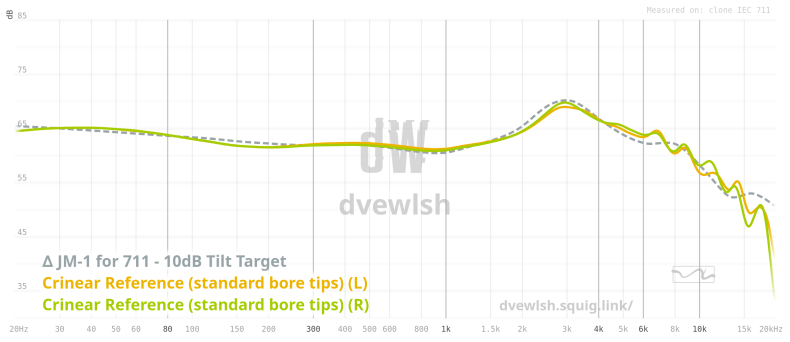
As Joel states in the video he released in 2024, this idea of the New Meta wasn’t a new goal, it’s the same goal as always to find a neutral IEM target, but powered by better information.
The Crinear Reference is a statement by showing what this New Meta JM-1 tuning really can be, and that the industry’s shyness to release anything without a significant bass boost has just been holding everyone back. Sure, everyone loves the Mega5EST or the other JM-1 with bass boost tuned IEMs like the Ziigaat Odyssey 2, but frankly, the massive bass boost on those sets helped to nullify the capabilities of JM-1 in its presentation. Even my beloved Softears Volume S came close, but couldn’t quite get away from adding warmth in the bass and mids, and colorations in the upper treble. Yet, the Reference is here with only a slight boost in the bass, and the perfect combination of quality drivers, and shows that great sound isn’t something limited to the kilobuck and up range, but was always achievable with the right research, driver configurations and engineering.
What all of this means is that at least to my ears, this IEM is a revelation. It’s that sort of sound I’ve been chasing since I got into the hobby, and leaves me genuinely excited to listen to my favorite music over and over again while wearing the Reference. I’ve heard a lot of IEMs since getting into the hobby, yet none have ever come this close to perfection. Yes, that can always change with exposure to more varied sets, as well as personal preference, but for me in this moment? The Crinear Reference is going to be incredibly difficult to beat for the price range.
While $350 is by no means inexpensive, it feels almost like a bargain for something that sounds this amazing. I still remember James Demer’s review of the Crinear Daybreak on the Linsoul channel, where one of his disappointments in the device was that he felt it simply sounded far too good for a $170 IEM, and would expect sound quality on that level to at least be $500 or $1,000 and come with better build quality. As it turns out, an improvement on the Daybreak on virtually every level didn’t even cost $500, it costs $350, and will give any IEM released on the market to this day a run for its money with how clear the sound is, how detailed it is, and just how smooth of an overall experience listening on the Reference really is.
Yes, it’s that good.
The Crinear Reference is a market disruptor on a basic level. The shells and presentation are understated and classy, the value is incredible, and the sound is next level, or at least far beyond what anyone else is doing right now. Right now is a key phrase, because I do think much like the Hisenior Mega5EST was a vanguard for the JM-1 with bass boost “new meta” years ago now, which led to an endless sea of copycats, I think the Reference is going to be the literal reference for how IEMs are tuned in the future. This can be the baseline, and any colorations can blossom out from this baseline. If they’ll sound as good as the Reference is another question entirely, but for now, the Crinear Reference is impossible to beat at the price point in the hobby and I very much look forward to seeing how the industry iterates from here. In a sea of bassy v-shapes, warm neutrals and JM-1 with bass boosts, the Reference stands alone.
The gauntlet has been thrown down. Go out there and show us what you can do.